
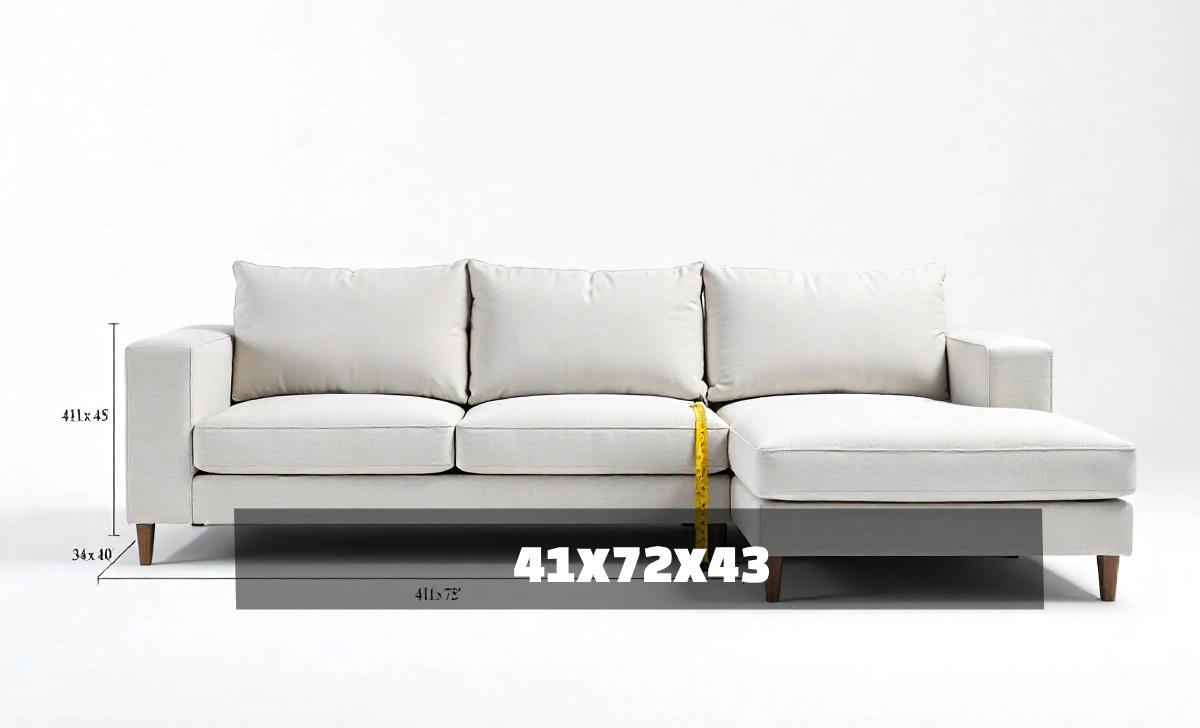
The measurement 41x72x43 represents three-dimensional specifications (width × depth × height) commonly found in furniture listings, particularly sectional sofas and wedge pieces. In inches, these measurements equal 104.1 × 182.9 × 109.2 centimeters, requiring approximately 73 cubic feet of space.
What Does 41x72x43 Mean?
Three numbers separated by multiplication signs indicate the physical dimensions of an object. The 41x72x43 format follows the standard convention where the first number represents width, the second indicates depth, and the third shows height.
The measurement appears in multiple contexts. In furniture listings, 41x72x43 inches describes medium-sized sectional pieces like corner wedges or modular components. In shipping documents, these same numbers in centimeters represent smaller packages suitable for personal transport.
Your priority is confirming the unit of measurement. Check product specifications for “in” (inches) or “cm” (centimeters). A 72-inch width differs dramatically from 72 centimeters—one fits large furniture, the other describes compact items.
Converting 41x72x43 Across Measurement Systems
Converting dimensions requires these standard factors:
- 1 inch = 2.54 centimeters
- 1 inch = 25.4 millimeters
- 1 foot = 30.48 centimeters
When 41x72x43 is in inches, the metric conversion becomes 104.1 × 182.9 × 109.2 centimeters. Converting from centimeters to inches produces 16.1 × 28.3 × 16.9 inches.
For millimeter conversions, divide each value by 25.4. To convert inches to feet, multiply by 0.0833. Always verify calculations twice before making purchase decisions or cutting materials.
Volume and Space Calculations
Calculate volume using this formula: Length × Width × Height = Volume. With dimensions of 41x72x43 inches, you get 126,696 cubic inches, which equals approximately 73.3 cubic feet.
Volume matters for several reasons. Shipping companies use dimensional weight calculations that can exceed actual weight when determining costs. Storage facilities charge based on cubic footage requirements. Material suppliers need volume data for insulation, packing materials, or protective coatings.
Surface area calculations help determine paint, fabric, or wrapping needs. The formula is: 2[(L×W) + (L×H) + (W×H)]. This tells you exactly how much material covers all six sides of a rectangular object.
Furniture Applications
The Ashley Next-Gen DuraPella sectional wedge measures 41×72×43 inches, serving as a cornerstone piece in modular seating arrangements. This wedge size works well in medium to large living rooms, providing the angled connection where two straight sections meet.
Sectional pieces range from compact two-seaters (around 75-85 inches) to oversized configurations (150+ inches). A 72-inch component falls into the medium-large category, suitable for rooms with at least 12 feet of available wall space when accounting for perpendicular sections.
When planning furniture placement, add 18-24 inches of clearance on all walking sides. This prevents cramped feelings that occur when furniture crowds traffic flow. For wall-positioned pieces, leave 2-3 inches behind to accommodate baseboards and prevent wall damage.
Reading Dimensions in Different Industries
Furniture retailers list width as the total width of your piece, including armrests, height from floor to top, including pillows, and depth as the total dept,h including cushions. A wedge measuring 41×72×43 inches would be 41 inches wide (front to back), 72 inches along the wall, and 43 inches tall.
Appliance manufacturers follow strict standards. A commercial unit listed at 41×72×43 might represent width × height × depth, with specific clearance requirements noted separately. Always check manufacturer diagrams showing which measurement corresponds to which side.
Shipping professionals measure the longest side first, regardless of orientation. They need to know how an item sits on a pallet and whether it requires oversized freight handling. A 72-inch measurement typically becomes the “length” in logistics systems, even if that dimension runs vertically during use.
Clearance and Tolerance Requirements
Manufacturing tolerances define acceptable variation from stated dimensions. Furniture dimensions include feet, legs, and bases, which in some cases are removable but not always. Furniture typically allows ±0.125 to ±0.25 inches variation.
Installation clearance serves different purposes. Appliances need airflow—usually 1-3 inches on the ventilation sides. Furniture requires swing space for doors and drawers. Recliners need 12-18 inches behind them when fully extended.
Delivery path dimensions get overlooked until the truck arrives. Measure doorways, hallway widths, and stairwell dimensions. A 72-inch item won’t fit through a 36-inch doorway unless it’s modular and breaks into smaller components.
How to Measure for Proper Fit
Start with the installation space. Use a tape measure to record the length and width of the area, noting permanent fixtures like radiators, outlets, or built-in shelving. Draw a simple floor plan on graph paper using a scale like 1 square = 1 foot.
Measure the delivery path next. Walk from the entry door to the installation spot, recording the narrowest point at each turn. Doorframes, hallways, and staircases all present potential obstacles. Measure diagonally through doorways—sometimes you can angle large items through openings they wouldn’t fit straight through.
Check overhead clearances, too. Low-hanging light fixtures, ceiling fans, and sloped ceilings interfere with tall items. Measure floor-to-ceiling height at multiple points if your room has architectural features.
Common Measurement Mistakes
Forgetting to account for packaging adds several inches to each dimension. Shipping boxes include protective materials and air space. If measurements show 41×72×43, boxed dimensions might be 44×75×46. This matters when scheduling delivery through narrow spaces.
Confusing interior and exterior dimensions causes frequent problems. Cabinet specifications might list exterior dimensions, while you need interior space for storage planning. Sectional “overall” dimensions include arms and backs, but seating area measurements exclude these elements.
Assuming all manufacturers follow the same conventions leads to errors. Some retailers list dimensions as width × depth × height, others use length × width × height. European manufacturers often present metric measurements even on products sold domestically.
Storage and Transportation Planning
Items measuring 41×72×43 inches require specific handling. Most standard pickup trucks can’t accommodate a 72-inch length with the tailgate closed. You’ll need either a vehicle with an 8-foot bed or a trailer.
When storing items this size, calculate not just floor space but vertical clearance. A 43-inch height limits stacking options. Climate-controlled storage works best for furniture, but outdoor storage requires weatherproof covering and elevation off the ground to prevent moisture damage.
Professional movers charge based on cubic feet and weight. Calculate volume (73.3 cubic feet for 41×72×43 inches) and get the estimated weight from the manufacturer. This information helps you get accurate moving quotes and avoid surprise charges.
Quick Reference Guide
In Inches: Standard size for medium-large furniture pieces requiring careful space planning and professional delivery
In Centimeters: Compact item suitable for personal transport, fits through standard doorways easily
In Millimeters: Small precision component, likely industrial or technical application
Volume: 126,696 cubic inches = 73.3 cubic feet = 2.07 cubic meters
Surface Area: Approximately 15,602 square inches = 108.3 square feet
Typical Applications: Sectional sofa components, storage furniture, commercial equipment, shipping containers
Frequently Asked Questions
What does 41x72x43 mean on furniture listings?
These numbers represent physical dimensions—typically width × depth × height. Always check product descriptions for the unit (inches or centimeters) and which measurement corresponds to which side.
How do I know if 41x72x43 will fit my room?
Measure your space and subtract 18-24 inches for walking clearance. Compare your measurements to the furniture dimensions after confirming which number represents width, depth, and height.
What’s the difference between inches and centimeters?
The same numbers in inches create a much larger object than in centimeters. 41x72x43 inches equals approximately 104x183x109 centimeters. Always verify the unit before purchasing.
Can a 72-inch piece fit through standard doorways?
Standard interior doors measure 30-36 inches wide. You cannot fit a 72-inch item straight through. Check if furniture is modular or plan to use larger openings like patio doors.
Do I need extra space for sectional furniture?
Yes, sectionals with reclining features need 12-18 inches behind them. Non-reclining pieces benefit from 2-3 inches for wall protection and cleaning access.
